

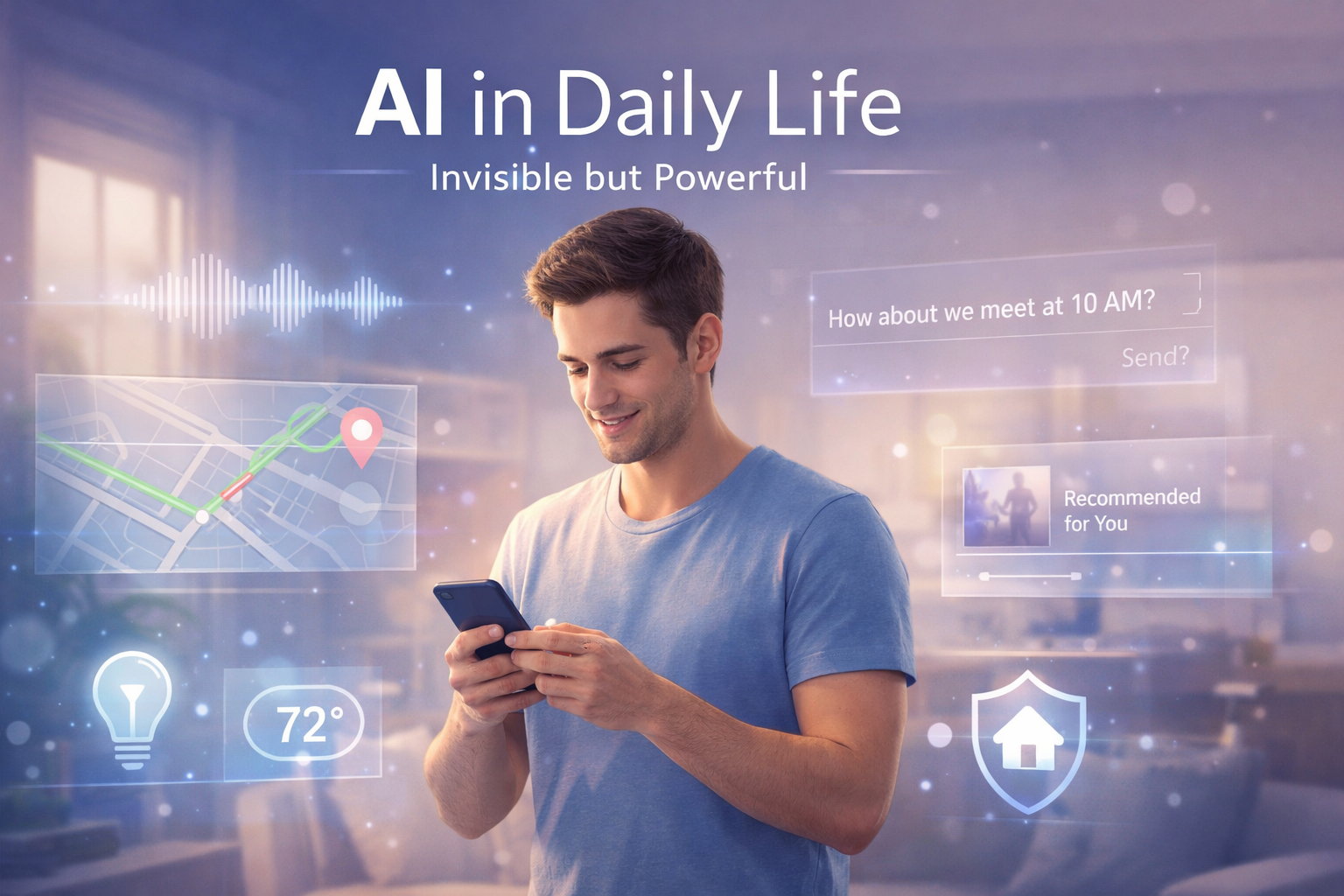
You woke up this morning and checked your phone maybe asked it about the weather or traffic. Small things. Routine things. But somewhere in that five-minute ritual, artificial intelligence already touched your day at least three or four times and you probably didn’t notice once.
That’s sort of the point.
Most people picture AI as a robot, a chatbot, some distant sci-fi thing. What they miss is that AI has already settled into ordinary life so quietly that we’ve stopped seeing it. The spam filter that kept last night’s phishing emails out of your inbox? That’s a trained model making judgment calls. The way your phone camera automatically brightens your face in a dim room? Also AI. The route your map app suggested this morning, accounting for an accident two kilometres ahead? You get the idea.
None of it waves a flag. It just works.
Think about the actual shape of a normal day.
You wake up. A streaming platform recommends a podcast based on your listening habits recommendation engines are among the oldest and most refined AI applications out there. You make a voice search while your hands are busy. Natural language processing figures out what you meant not just what you said.
At work you type an email and autocomplete offers the next phrase. You might barely notice it but there’s a language model predicting your sentence, having trained on billions of examples. If your company uses any customer service tools fraud detection systems or even basic data dashboards AI is almost certainly involved somewhere in the backend.
In the evening, your streaming service has a surprisingly good suggestion waiting. Your social feed seems to know what you’ll stop scrolling for. Ads — annoying as they are — are specifically targeted based on patterns your behavior created over months. All of this is AI doing its job: pattern recognition at a scale no human team could manage.
It goes beyond convenience. In hospitals, AI tools are helping doctors read scans and flag abnormalities that might take a tired human eye longer to catch. That’s not replacing doctors — it’s giving them a sharper second opinion. In education, adaptive learning software adjusts the difficulty and style of practice problems based on how a student is responding. A struggling student gets more support. A fast learner doesn’t sit through material they’ve already mastered.
These aren’t futuristic prototypes. They’re running right now, in cities everywhere.
None of this comes without questions worth asking. Who owns the data that trains these systems? When an AI recommendation shapes what news you read or what products you buy, is that neutral or is it steering you somewhere someone else decided? These are real concerns, not just academic ones. The more invisible AI becomes the more important it is that people understand it’s there. The goal isn’t fear. It’s awareness.
AI isn’t arriving. It’s been here embedded in the mundane fabric of how we navigate the day. The apps, the suggestions, the filters and the auto-corrections they’re all small implementations of something genuinely large. Getting familiar with that even a little, matters. Not because you need to become a technologist, but because these tools shape decisions, habits, and what feels normal over time.
Invisible doesn’t mean unimportant. If anything it means the opposite.