

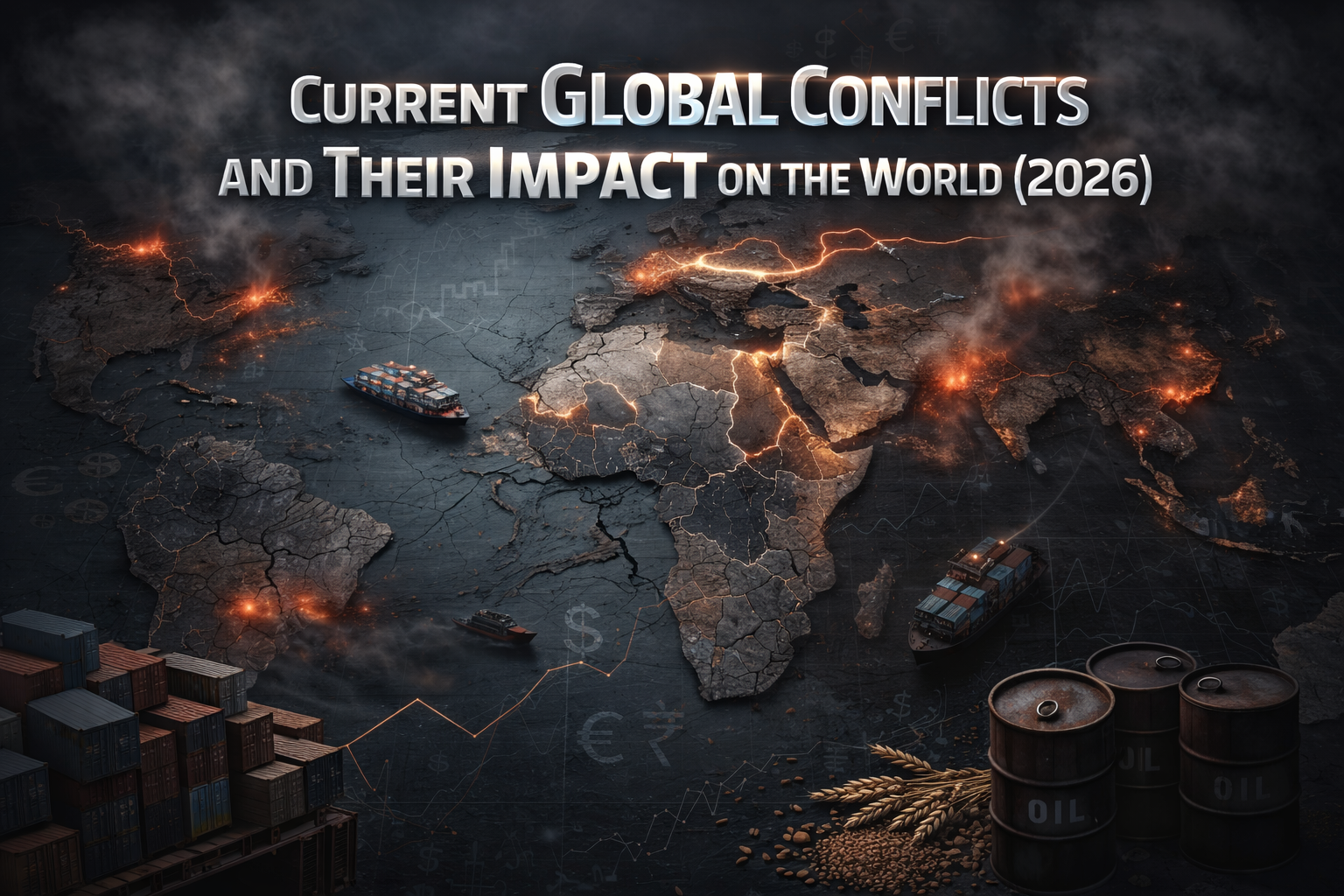
Some wars feel distant until they aren’t. The conflicts playing out right now in Ukraine, in Gaza, in Sudan aren’t just news stories that scroll past your feed. They’re quietly reshaping grocery prices, energy bills and the kind of geopolitical world that’s being built while most of us go about our days. Understanding what’s actually happening, and why it matters beyond the immediate region, is worth the effort.
Russia invaded Ukraine in 2022 and the war is still going. What many expected to be a short, contained conflict has dragged on for years pulling in NATO allies, straining Western political consensus and fundamentally disrupting how Europe thinks about its own security.
The economic spillover has been significant. Ukraine was one of the world’s biggest exporters of wheat and corn. Russia is a leading supplier of oil and natural gas. When both are entangled in a prolonged war, global supply chains take a hit. Prices rise. Governments scramble. And ordinary people in countries far removed from the fighting end up paying more for food and heating. The involvement of Western nations has deepened the complexity of the conflict, making a quick resolution increasingly unlikely.
The conflict escalated sharply in October 2023 and hasn’t wound down. The humanitarian toll has been severe widespread civilian casualties, mass displacement and an infrastructure crisis in Gaza that international aid organizations are struggling to address.
Beyond Gaza’s borders, the ripple effects are real. Iran’s involvement has raised the stakes considerably, and the risk of a broader regional conflict isn’t hypothetical it’s the scenario that diplomats are actively working to prevent. The situation remains volatile, with ongoing tensions straining not just the Middle East but global political relationships as well.
This is a situation that is happening without many people realizing it and yet it is a situation that needs to be highlighted more. In April 2023, Sudan witnessed a situation in which the rival factions in the country’s military turned on themselves, and what followed is a crisis that is arguably one of the worst in the world and one of the least covered.
Some of the statistics are quite staggering. There are millions of people who have been displaced from their homes. In most of Sudan, there is a critical lack of food, water, and medical rations. What is perhaps more worrying is that the response to this crisis from other nations of the world is perhaps not adequate. If other crises are to be taken into context, which are perhaps more or as severe as what is happening in Sudan, it is a crisis that is perhaps not getting as much attention or support as it needs.
Wars do not confine themselves to boundaries in a very interconnected world. The conflict between Russia and Ukraine sent shockwaves across the globe, disrupting the balance of oil, natural gas and other vital agricultural commodities that a country needs. The result is increased inflation, increased costs of living and a slowdown in economic activities across different nations.
Businesses are no exception. Fluctuating commodity prices and a volatile supply chain are a source of uncertainty for businesses, adding to economic instability.
The country has been one of the main providers of wheat, corn and other cereals to the world that was feeding a significant part of the world’s population. The war has destroyed this causing food prices to increase across the world and further tightening food security in developing countries that depend on imports. The most affected are always the vulnerable, as when prices increase and access to food becomes limited and it is always the poor who are in real danger of starvation and poor nutrition.
The sanctions against Russia and the subsequent effect on Russia’s energy exports forced countries particularly in Europe, to rethink from where they were sourcing power. The shift away from Russia’s energy has been genuine and in some ways it has accelerated investment in renewables. The cost however, has been high particularly in terms of higher energy costs, supply and politics as governments sought to manage this shift while ensuring that consumers were not disadvantaged.
The most visible and immediate effect of these conflicts is on the people. Millions are displaced from Ukraine, Sudan and Gaza and this has created massive refugee crises for these nations and for the world at large. Food, water, healthcare and housing are basic needs that are a constant struggle for many, who view them as daily battles rather than basic requirements. Relief efforts are in full swing to help these people but the demand for help seems to always outstrip supply.
These conflicts have changed the political map in ways that will take years to fully understand. Relations between major powers are more strained than they’ve been in decades. Countries are picking new sides. Military spending is climbing in most regions, with countries reassessing their defense strategies in response to a less predictable world.
The concern isn’t just about today’s conflicts but it’s about what the current trajectory makes more likely tomorrow. A world with higher military spending, weaker international trust and more entrenched power rivalries is a world where future conflicts become easier to start and harder to stop.
The world doesn’t compartmentalize the way we would like it to. A war in Eastern Europe raises food prices in West Africa. A conflict in the Middle East shifts energy calculations in Europe. A civil war in Sudan creates a refugee crisis that most of the world barely registers. These are not separate stories actually they are connected and their effects reach further than any of them appear to on a map.
What all of this points to is something uncomfortable but important: the need for genuine diplomatic effort, sustained international cooperation and a serious commitment to peace and not as abstract ideals but as practical necessities in a world that’s far more fragile and interdependent than it often seems.
This piece is based on publicly available information from news reports, research articles and global organizations. It’s meant to inform and educate and doesn’t represent personal opinions or official positions.