

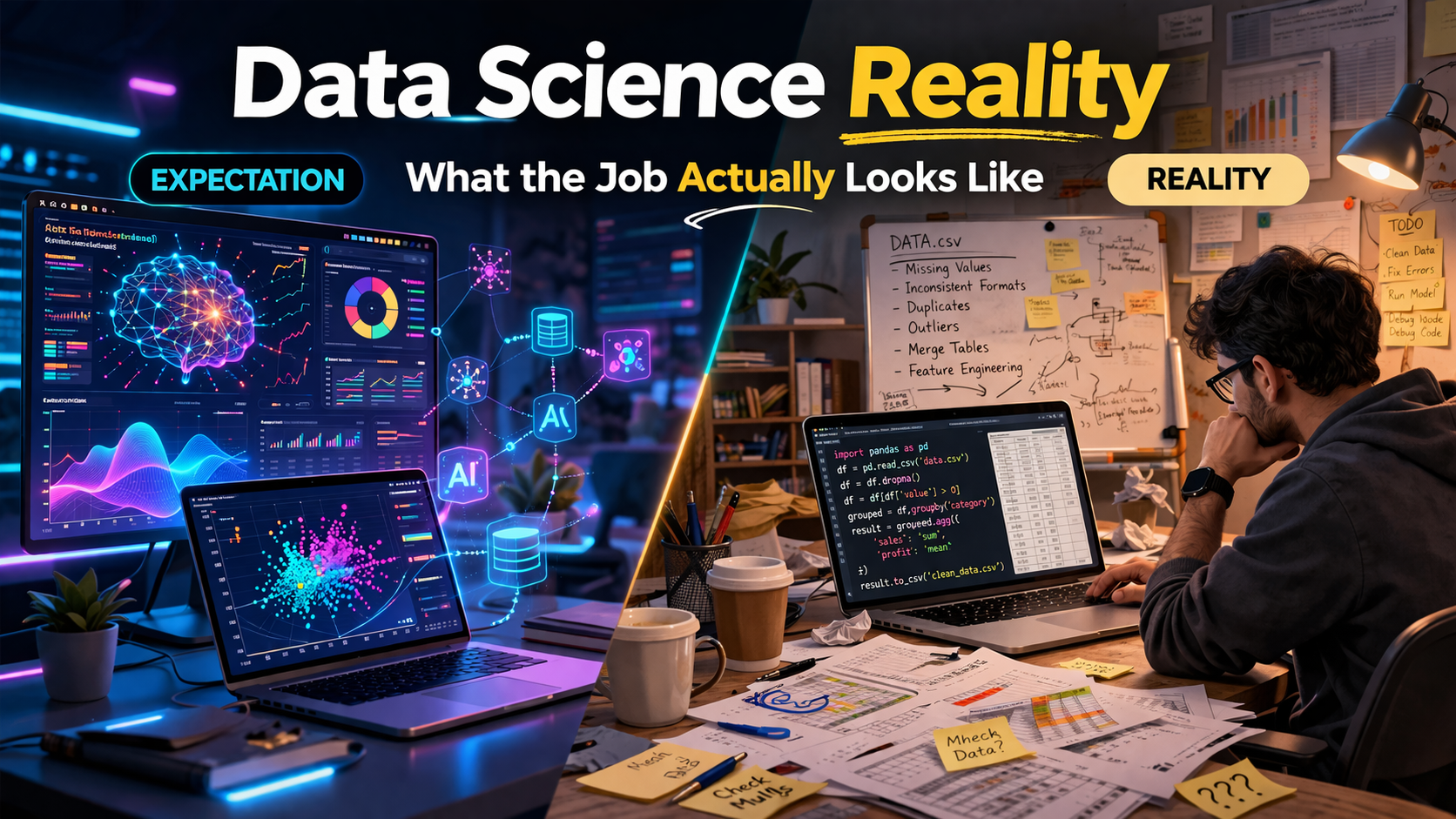
Everyone talks about data science like it’s some kind of magic. You feed numbers into a laptop, some algorithm crunches away and boom and insights that change the world. That’s the image.
Then you actually start doing it.
I’m not here to scare you off the field. Data science is genuinely interesting and the demand for people who can do it well is real. But the gap between what people expect and what the job actually looks like day-to-day is wide enough to cause serious burnout especially for people who come in with the wrong picture. So let’s be honest about it.
Here’s the story most beginners hear: a Data Scientist sits at a sleek workstation, trains neural networks, presents jaw-dropping visualizations to executives and earns a six-figure salary straight out of a bootcamp. The job is 90% model building, 10% explaining your genius to grateful stakeholders.
People also tend to believe the tools do most of the work. Learn data science they say learn Python, run model.fit(), collect your paycheck. They see job postings demanding “Experience with Machine Learning” and assume ML is what the job actually involves most of the time.
A lot of aspiring data science beginners also assume the data comes ready to use. Clean, labeled, complete. Like a Kaggle dataset but for real money.
Here’s what the job actually looks like: You will spend most of your time on data that is broken.
Missing values, duplicate rows, columns with three different names across three different exports. Dates stored as strings. Strings that are secretly numbers. Numbers that turn out to be text someone typed by hand in 2011.
A common estimate among working data scientists is that 70–80% of the job is cleaning and preparing data. The model itself takes a fraction of the time. And when a model does go into production, maintaining it , monitoring drift, debugging pipelines, retraining when the business logic changes is its own ongoing job.
The other thing nobody warns you about: Communication. You can build a perfect model and have it completely ignored because you couldn’t explain why it matters to someone who doesn’t know what a confusion matrix is. Writing, presenting and translating technical work into plain language is half the job. This is the real data scientist reality that most courses skip.
The honest data science skills roadmap looks like this:
- Python or R – Not just knowing the syntax but writing code that other people can actually read and maintain.
- SQL – Non-negotiable. Most data lives in databases and if you can’t query it yourself, you’re dependent on someone else for every question you want to answer.
- Statistics – The real kind of. Distributions, hypothesis testing, confidence intervals. ML libraries won’t save you from drawing the wrong conclusions if your statistical instincts are weak.
- Data wrangling – Pandas, dplyr or whatever the tool is. This is where you’ll actually spend your time.
- Communication – Written and verbal. If you hate writing reports or talking to non-technical people, that’s worth knowing before you commit to this career.
- Curiosity and patience – Arguably the most underrated. Data problems are often ambiguous.
- Machine learning – On the list too but further down than most people expect.
Understanding the difference between a data analyst vs data scientist also matters here analysts lean heavier on SQL and reporting, scientists lean into modeling and experimentation.
Take a company that wants to reduce customer churn. The expectation: someone builds a churn prediction model, the model flags at-risk customers, the retention team swoops in, problem solved.
The reality: First you spend two weeks figuring out what “churn” even means for this company. Is it cancellation? Inactivity for 30 days? 90 days? Different teams define it differently. Then you discover the CRM data has a 40% match rate with the billing data. Then the feature you wanted to use number of support tickets turns out to be logged inconsistently across regions.
By the time you have a clean dataset, half the project timeline is gone. You build the model. It performs reasonably. But the retention team wants to know: which customers should we call first? That’s not a model question anymore but that’s a business prioritization question. Now you’re in meetings. This is the real data science day in the life.
So, is data science worth it? Yes, if you go in clear-eyed. The problems are real, the pay is competitive and if you genuinely like puzzles made of messy data, you’ll find it satisfying.
But the job is less about algorithms and more about asking the right questions, cleaning up after systems that weren’t designed with analysis in mind and getting non-technical colleagues to trust what you’re telling them. The model is maybe 20% of it.
If that sounds less glamorous than the bootcamp ads promised good. People who last in data science career paths are the ones who actually like the unglamorous parts. That’s the real difference between data science myths and the truth.