

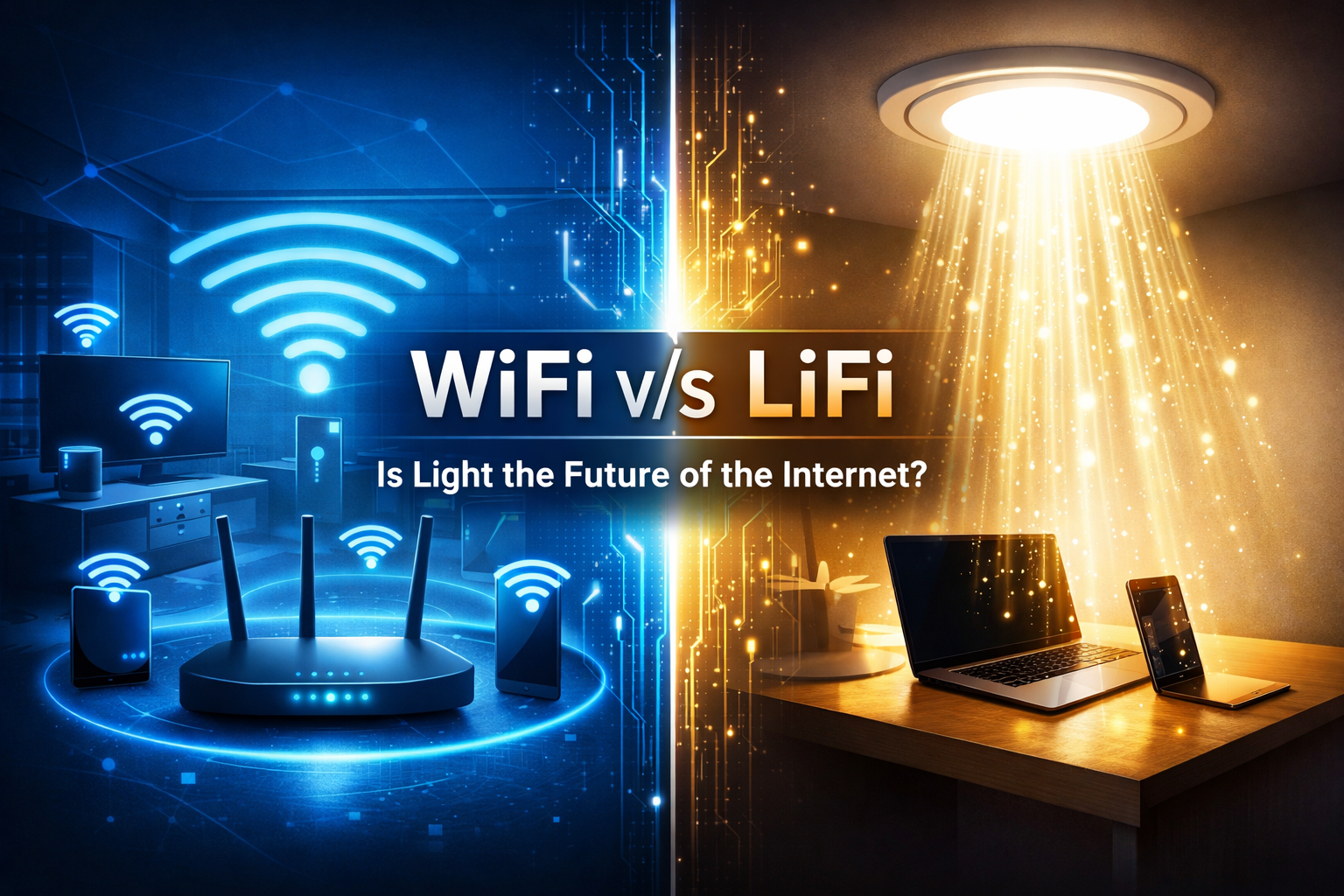
WiFi has been running our wireless world for 25+ years. It’s invisible infrastructure at this point , like expecting the tap to run when you turn it. Then along comes LiFi (Light Fidelity) using LED light pulses to carry data, promising speeds that make WiFi look slow by comparison. So what’s the real difference, who wins where and should anyone actually care yet?
WiFi sends data over radio waves of 2.4 GHz and 5 GHz bands between your devices and a router. It goes through walls, covers 30–50 metres indoors and connects everything from your phone to your smart fridge without you thinking about it. Wifi technology (IEEE 802.11) has iterated steadily and WiFi 6 now reaches 9.6 Gbps in ideal conditions, though most people’s home connections deliver a fraction of that. It works because it’s everywhere and everything supports it.
- Universal compatibility : Every device you own supports it, no extra hardware needed
- Passes through walls : One router covers a whole floor, no line-of-sight required
- Long range : Works indoors and outdoors up to 50m+, extendable with mesh systems
- Multi-device handling : WiFi 6 manages 75+ simultaneous connections without collapsing
- Mature ecosystem : Billions of compatible devices, cheap hardware, years of troubleshooting knowledge
- Works in the dark : Doesn’t need lighting to function
- Easy roaming : Move through a building and stay connected seamlessly
- Spectrum congestion : Dense areas (apartment blocks, airports) turn 2.4 GHz into a traffic jam
- Signal bleeds through walls : Anyone nearby can attempt to intercept it
- Interference : Microwaves, baby monitors, neighbouring networks all compete on the same bands
- Restricted environments : Hospitals, aircraft, military zones limit or ban radio wave usage
- Limited spectrum : The RF bands WiFi uses are finite and increasingly crowded
- Speed ceiling : 9.6 Gbps (WiFi 6) sounds fast, but LiFi lab results leave it far behind
Professor Harald Haas coined the term in 2011 at the University of Edinburgh. The core idea is LED lights can flicker millions of times per second , far too fast for human eyes and those flickers carry data. Your lamp becomes a transmitter. A small photodetector on your device receives the signal. This is Visible Light Communication (VLC) and it uses a completely different slice of the electromagnetic spectrum than WiFi.
In 2023, it got its own formal standard: IEEE 802.11bb. Lab speeds have hit 224 Gbps. Real commercial deployments from companies like pureLiFi run at 1–10 Gbps. The hardware exists and it’s not vaporware.
- Raw speed : 224 Gbps in lab conditions , commercial units already at 1–10 Gbps, faster than most WiFi deployments
- Massive spectrum : The visible light spectrum is 10,000× wider than all RF bands combined , congestion is not a concern
- Security by physics : Light stops at walls, so the signal is confined to the room. No encryption can do what a wall does.
- Zero RF interference : Works alongside WiFi, 5G, Bluetooth without conflict, safe near sensitive medical equipment
- Usable where WiFi is banned : Aircraft cabins, hospital wards, military facilities, underwater light waves go where radio can’t
- Line-of-sight only : Block the light beam (with your hand, a bag, your body) and the connection drops. Walls are complete barriers.
- Needs constant light : The LED must stay on to transmit data, even if you don’t want the room lit
- No outdoor use : Sunlight and other light sources interfere, LiFi is strictly an indoor technology
- Limited range : Typically effective up to 10 metres per access point, large spaces need many units
- High setup cost : Requires LiFi-capable LED fixtures and receiver hardware, retrofitting is expensive
Probably not and that’s not a knock on LiFi. WiFi covers ground. It goes through walls, works outside and handles your phone as you walk room to room. LiFi can’t do that. What LiFi does is deliver very fast and very secure connectivity in a defined space. Those are different jobs.
The realistic future is a hybrid setup : LiFi inside operating theatres, secure server rooms, aircraft cabins and dense office pods. WiFi handling everything else. The two don’t fight but they split the work. Whether that future arrives in five years or fifteen depends mostly on whether device manufacturers start putting LiFi receivers in hardware by default. Until that happens, LiFi stays a specialist tool and not a household name.