

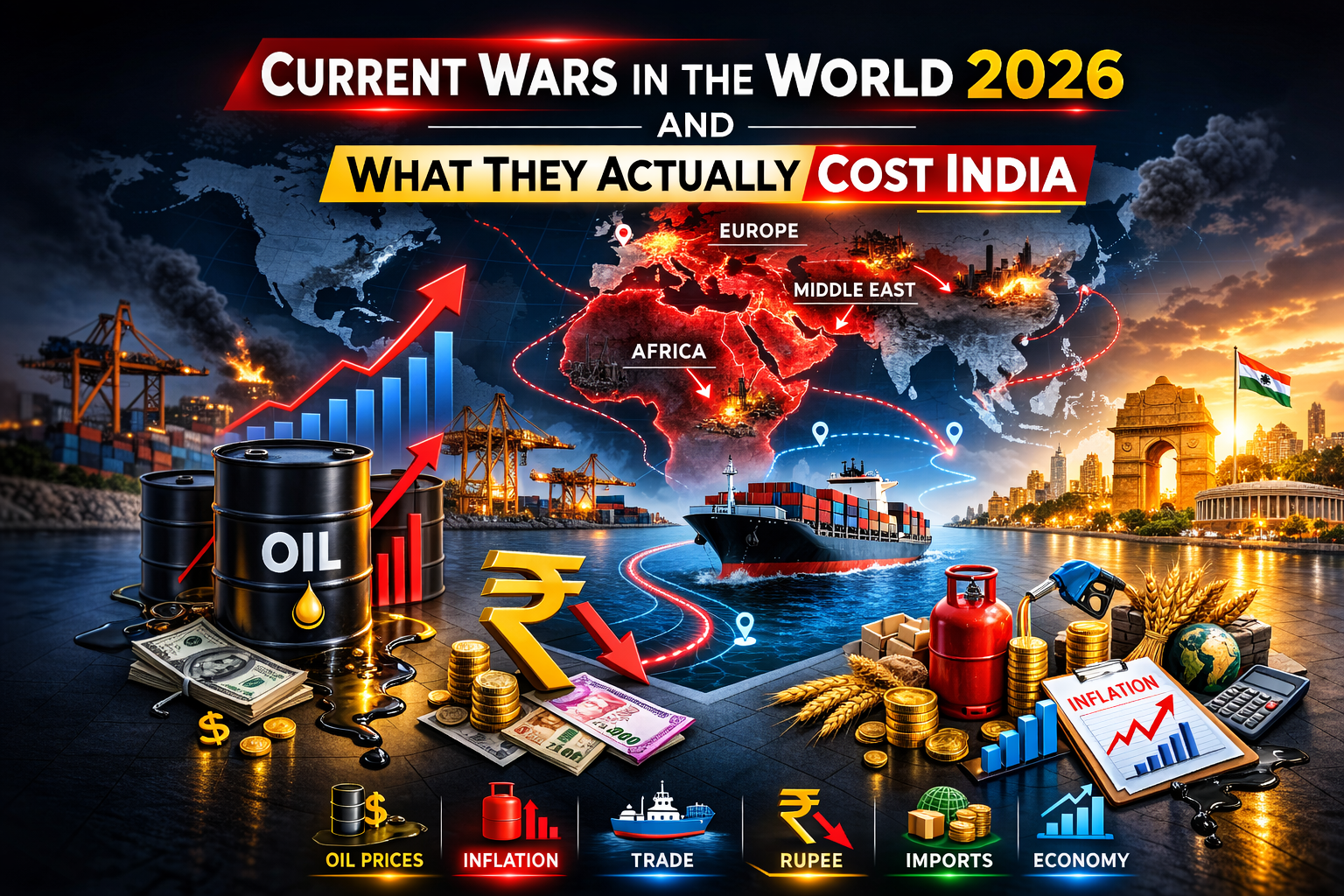
Three major wars are burning right now, and India isn’t in any of them. Russia and Ukraine have been fighting for four years. Israel and Hamas have been at war since October 2023 a conflict that has since pulled Iran, the U.S., and half the Middle East into its orbit. Sudan has been in civil war since April 2023, with over 12 million people displaced. These are the most consequential ongoing wars of 2026, and none of them are India’s fights. Yet the consequences land here in fuel prices, in shipping delays, in a weakened Indian rupee, in an overworked government trying to manage it all without picking sides.
Understanding the impact of these global conflicts on India’s economy is not an academic exercise. The family paying more for cooking gas, the textile exporter in Surat absorbing higher freight rates, the farmer dealing with expensive fertilizer they are all, in some quiet way, paying for wars they never voted for. That’s what it means to be a large, import-dependent economy in an era of escalating global conflict.
India imports 85% of its crude oil. When conflicts threaten oil-producing regions or shipping routes, pump prices rise, subsidy costs climb, and the entire economy feels it.
After Russia invaded Ukraine, India quickly ramped up discounted Russian crude from 2% to nearly 35% of all imports. Good margins, avoided inflation. But by 2026, the U.S. slapped a 25% tariff on Indian exports tied to Russian oil purchases. India cut back, and now buys more expensive Middle Eastern oil instead.
The Strait of Hormuz India oil risk is real 21 million barrels pass through it daily. When Iran retaliated against U.S. and Israeli strikes in 2026, oil prices jumped, India’s LPG price hike became a household problem, and the ₹2T subsidy budget started looking thin. If crude crosses $100/barrel, the extra bill could hit ₹500 billion.
Wars don’t target India’s trade , they just happen to run through it. The Red Sea disruption forced ships onto the Cape of Good Hope route, adding 10–14 days and up to $1,200 per container. For Indian textile, pharma, and engineering exporters shipping to Europe, that’s a direct hit to margins.
On imports: Ukraine’s sunflower oil ($1.9B/year) disappeared almost overnight, pushing edible oil prices up. Russia-Ukraine war India fertilizer prices rose sharply when Belarus-Russia potash exports got sanctioned, raising farm input costs.
India’s Chabahar port project (INSTC corridor through Iran) is at serious risk from the Iran conflict and renewed U.S. sanctions. Meanwhile, the IMEC corridor India is backing bypassing Iran entirely has gained strong U.S. support. Two bets, pointed in opposite directions.
More oil spending means more dollar demand which weakens the rupee. It fell from ₹83 in early 2025 to around ₹86 by early 2026. A weaker rupee makes every import costlier: oil, electronics, chemicals, machinery. That cost quietly filters into everyday prices.
LPG is the clearest example. When the government absorbs the higher cost, the fiscal deficit grows. When it passes it on, households pay more. Either way, India’s inflation and war oil prices are tied together tightly right now.
India’s “strategic autonomy” and non-alignment policy buy cheap energy anywhere, stay neutral, keep all relationships is getting stress-tested. The U.S. pushed India off Russian crude. The Chabahar port investment through Iran is now caught between sanctions and active conflict. India’s defence imports from Israel (~$150M/year) also face supply uncertainty mid-conflict. And India’s wheat export opportunity opened up by Ukraine’s disruption risks closing if shipping costs stay high. India is simultaneously courting Washington and Moscow, satisfying neither fully.