

If you have been running a business for a while or you’ve probably hit the wall that sales tracked in one spreadsheet, inventory in another and HR living in someone’s inbox. Everything works until it doesn’t. That’s usually when people start searching for an ERP.
Odoo is one of the most searched ERP platforms right now and for good reason. Here’s what Odoo actually is, what it does and whether it’s the right fit for your business.
Odoo is an open source ERP and business management software that covers a wide range of operations: accounting, sales, inventory, HR, manufacturing, project management and much more. It started in 2005 as a small Belgian startup called TinyERP, went through a rename to OpenERP and became Odoo in 2014.
Today, it has over 7 million users across 150+ countries. The core codebase is free. You pay for hosting or for certain enterprise-only Odoo modules.
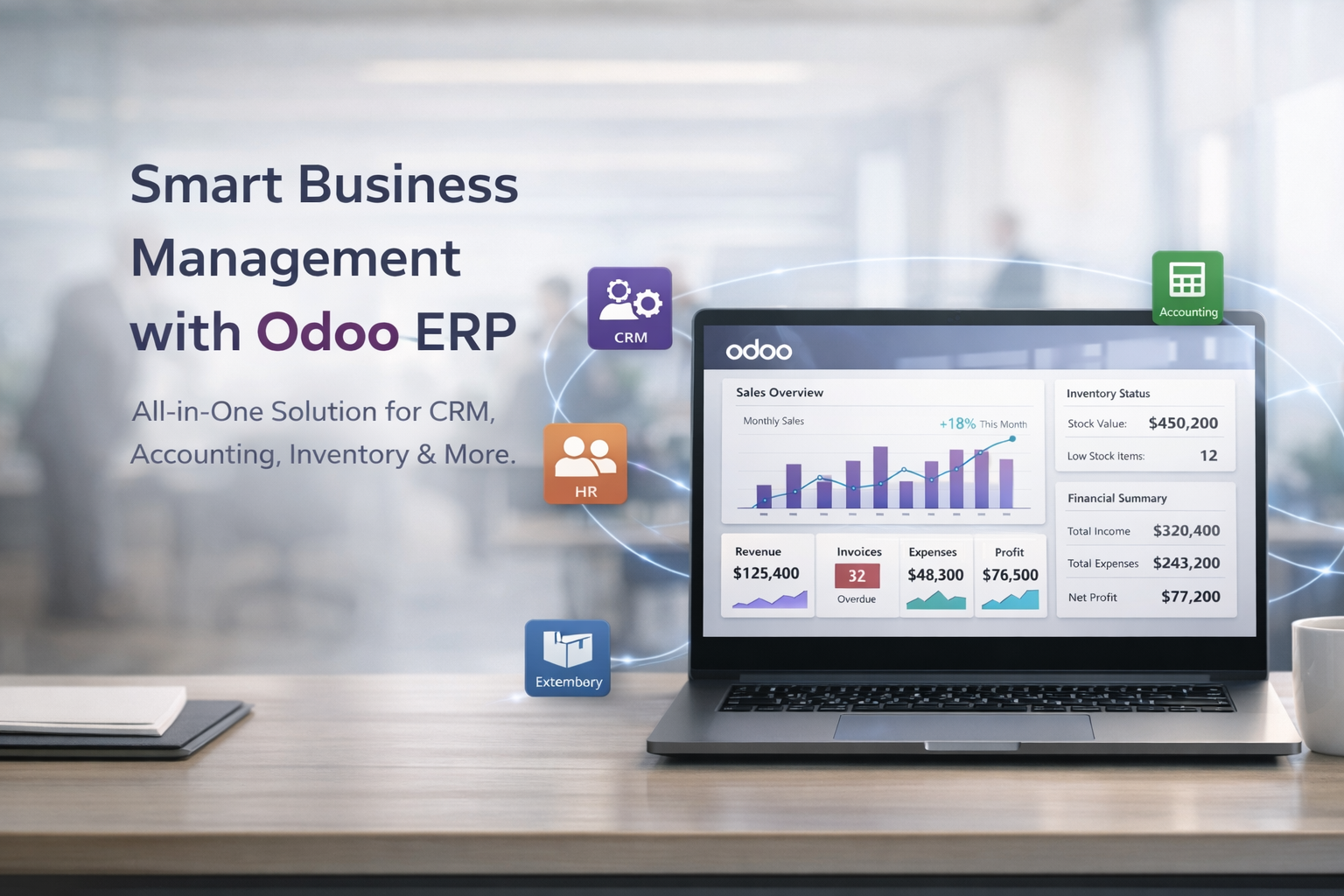
Odoo works on a modular system. You don’t install one big piece of software. You pick the Odoo modules your business actually needs.
The most commonly used ones:
- Odoo CRM :- tracks leads, pipelines and customer communication
- Odoo Sales :- manages quotes, orders and contracts
- Odoo Accounting :- handles invoices, taxes, bank reconciliation
- Odoo Inventory :- real-time stock tracking, warehouse management
- Odoo HR :- employee records, leave management, payroll
- Odoo Manufacturing :- production orders, bills of materials, work centers
- Odoo Website \& eCommerce :- build a site and run an online store both connected to your back-end inventory
Because everything is on the same platform and the same database, your sales order automatically updates inventory, which feeds accounting, without anyone copying data between apps.
This is where a lot of beginners get confused. Odoo has two versions:
Community Edition is free and open source ERP. You can download it, host it yourself and use it without paying Odoo anything. The limitation is that some Odoo modules are missing and you don’t get official support.
Enterprise Edition adds more modules (like payroll and field service), a better UI and access to Odoo’s own cloud hosting. Odoo pricing starts around $9.10/user/month for the standard plan as of 2025, though it varies by region and plan.
For very Odoo for small business setups or startups willing to self-host, Community is a viable starting point. For most growing businesses, Enterprise is the practical option.
Odoo works across industries. Manufacturing companies use it for production planning. Retail businesses use the POS and eCommerce modules. Service companies use project management and timesheets. It scales from a 3-person team up to companies with thousands of employees.
It’s probably not the right tool if you need deep industry-specific functionality like healthcare compliance software, oil & gas ERP. For those cases, specialist platforms exist. But for general business operations, Odoo covers a lot of ground.
The fastest way to try it is through Odoo’s free 15-day trial on their website. You pick a few Odoo modules, enter some basic info, and you have a working instance in about two minutes.
If you’re evaluating it seriously, it’s worth talking to an Odoo implementation partner these are companies certified by Odoo who handle setup, customization, and training. Going in solo without any technical background is doable for simple setups, but the moment you need customization or data migration from old systems, you’ll want help.
Odoo ERP is genuinely useful software that a lot of businesses underutilize or never find because they’re looking at pricier options first. It’s not magic but a bad setup will still cause problems but the architecture is sensible, the module list is wide and the cost of entry is low enough to test before committing.
If your operations are fragmented across tools that don’t talk to each other, Odoo is worth a serious look.