

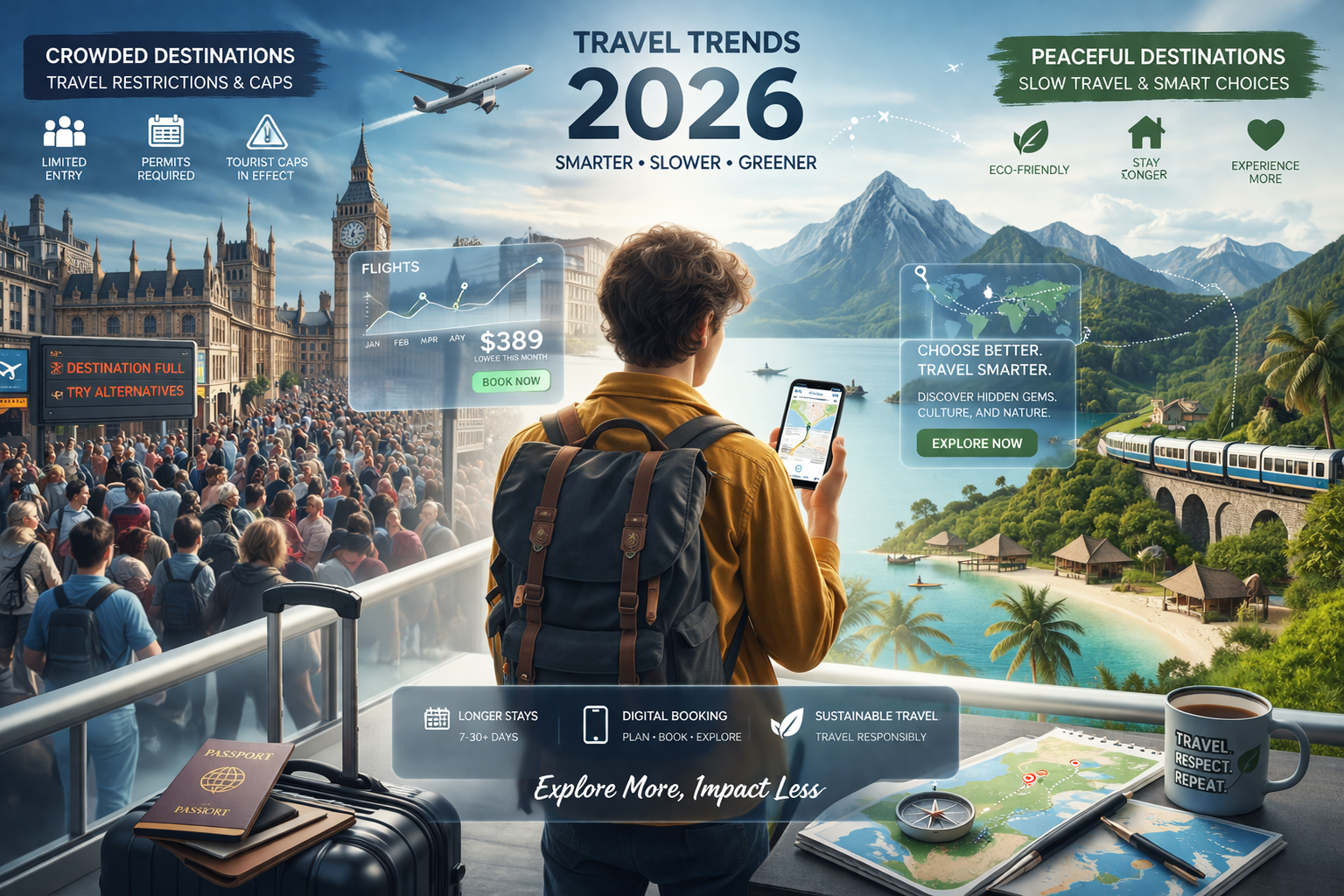
Travel in 2026 is shaped by a few hard shifts: airfare on high-demand routes is up compared to pre-pandemic baselines, several European cities have introduced tourist caps or entry fees and travellers are booking longer stays in fewer places rather than racing between countries. The fundamentals of good travel planning have not changed but some tactics that worked three years ago work less well now. This guide focuses on what is current.
A handful of destinations are drawing attention in 2026 for combining accessibility, affordability, and infrastructure that holds up under increasing visitor numbers. Uzbekistan particularly Samarkand and Bukhara has seen a sharp rise in independent travellers since visa restrictions loosened. Albania offers Adriatic coastline at a fraction of Croatian prices. In Asia, Sri Lanka has stabilised economically and rebuilt its tourism infrastructure after a difficult 2022–23 period.
Slovenia is worth particular attention for European adventure travel it has mountain terrain, cave systems and cycling infrastructure comparable to Switzerland and Austria at lower cost and with far smaller crowds. Ecuador, covering both the Galápagos and Andean trekking, suits travellers who want variety within a single travel itinerary without crossing multiple borders.
The old rule of booking flights as far in advance as possible is less reliable in 2026. Airlines have become better at dynamic pricing, which means early bookings are not always the cheapest. The most consistent approach is to set fare alerts four to ten weeks out and move when prices drop. Flexibility on departure day still cuts costs mid-week departures run 10–20% cheaper on average than weekend flights on comparable routes.
For backpacking routes in 2026, Southeast Asia remains the most cost-effective region in the world for extended travel. Vietnam, Indonesia, and the Philippines each offer low daily costs, good transport links and enough variety to sustain trips of several weeks without repeating experiences.
Solo travel continues to grow. Most cities with established tourism infrastructure are straightforward for solo travellers the risks are overstated in most Western media coverage. The practical checklist remains the same: share your travel itinerary with a contact at home, carry travel insurance that covers the specific activities planned, and keep digital and physical copies of key documents.
Train travel has expanded significantly across Europe and parts of Asia in 2026, making rail a practical alternative to short-haul flying on more routes than before. London to Amsterdam, Paris to Barcelona, and Tokyo to Osaka are all faster or comparable by train once airport time is factored in and emit roughly 80% less carbon per passenger than the equivalent flight.
The destinations holding up best under increased visitor numbers in 2026 are those that have managed access deliberately through entry permits, dispersed itineraries, or accommodation caps. Travelling to these places during shoulder season (April–May, September–October in most of Europe and Asia) still makes a measurable difference to crowd levels and prices.
Travel in 2026 rewards flexibility over rigid planning slower trips, smarter booking and well-chosen destinations deliver more value than ever before. The tools and options available to independent travellers have not shrunk, they have just shifted and knowing where to look makes the difference.